
Taking a degree requirement off a job post takes about a minute.
Changing who actually gets hired takes a lot longer.
This one is for hiring managers, HR leaders and founders who have said "we hire for skills" and meant it.
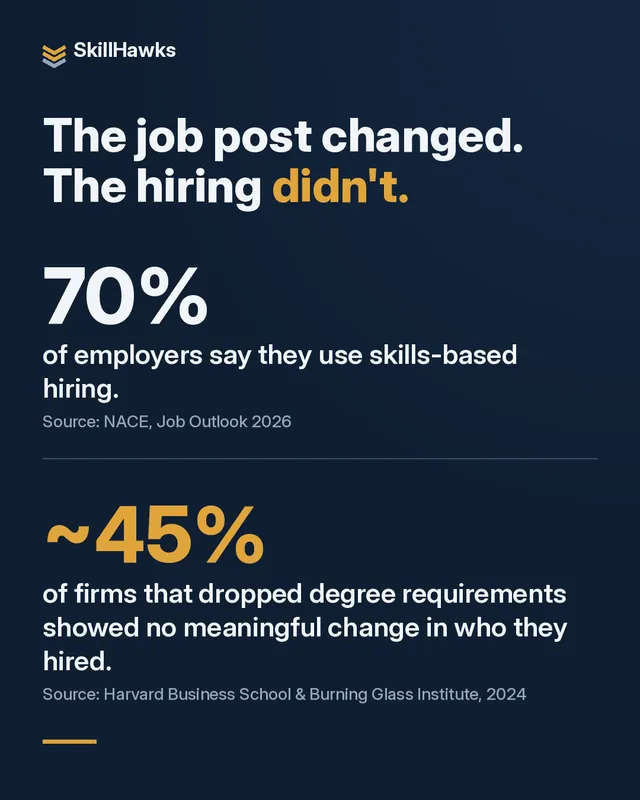
In NACE's Job Outlook 2026 survey, 70% of employers said they use skills-based hiring.
But when Harvard Business School and the Burning Glass Institute looked at what happened after large firms dropped degree requirements, about 45% of those firms showed no meaningful change in who they hired. The posting changed. The hiring didn't.
That gap usually isn't bad intent. The old filter just moves somewhere quieter:
- The résumé screen still looks for familiar school and company names.
- The "must-haves" are a wish list nobody has ranked.
- Each interviewer asks whatever they like, and the debrief runs on gut feel.
- "Fit" becomes shorthand for "similar to the last hire."
What tends to change outcomes is less visible work:
- Write down what the person must be able to do in their first six months.
- Agree on the three to five things that would genuinely rule someone out.
- Give each interviewer one skill to assess, with the same questions for every candidate.
- Use a short work sample that looks like the real job.
- Score candidates before the debrief, not during it.
- A few months in, look at who you actually hired. Did the mix change?
Have you hired someone without the "usual" background for a role, or been that hire yourself? What convinced the team to say yes?