
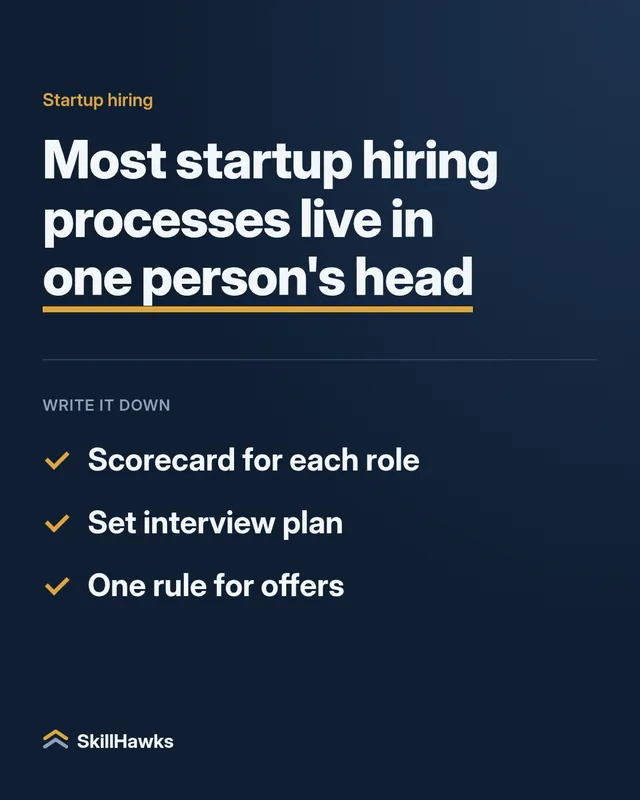
Most early-stage companies have a hiring process. It just lives in one person's head.
The founder knows what good looks like for the role, which questions matter, who should meet the candidate, and what they're willing to offer. It works, because they're in every conversation.
Then two managers start hiring at the same time, and the process can't be in both rooms.
A few signs it's time to write it down:
- Two people interview the same candidate and are looking for different things.
- Offers are decided case by case, and nobody can explain last month's number.
- Candidates wait a week after the final interview because the one person who decides is away.
- New managers run their first hire by copying whatever happened to them.
- "We'll know them when we see them" is the job description.
None of this needs a big HR team. It needs a one-page scorecard for each role, a set interview plan, an owner for each step, and a simple rule for how offers get decided.
Having someone own it pays off early, too. In Ashby's 2026 report on more than 1,200 venture-backed startups, time to hire at companies under 25 people dropped by almost 30% when a recruiter was involved.
If you've helped build a startup's hiring process from scratch, what was the first thing you wrote down? What would you add to this list?